Best Job Boards for Employers Compared by Price and Reach
Compare the best job boards for employers by price and reach, from LinkedIn to niche healthcare sites, before you post your next role.

The best employer job posting sites for hiring allied health staff range from $0 a month to $1,000 or more, and the gap comes down to how much visibility you want on top of the free listing. LinkedIn lets you post one job free at a time, but it pauses after 14 days and expires at 30 unless you pay to promote it. Push that same post into LinkedIn's Job Slots program and you're looking at $200 to $1,000 per slot per month on an annual contract. Indeed sits in between, with 3 free postings a month and sponsored ads that typically run around $5 a day, or roughly $150 a month, billed by the click.
Price is only half the problem. A phlebotomist opening or a radiology tech posting can get posted on Indeed next to thousands of generic admin jobs, recycled staffing-agency listings, and roles that have nothing to do with allied health, which means your post has to fight for attention even after you've paid for it. The same risk applies on LinkedIn and Monster+, where healthcare openings sit inside a general feed built for every industry at once. Comparing price against reach for roles like surgical tech, respiratory therapist, or cardiac sonographer means looking past the sticker price and checking who actually sees the post once it's live.
Table of Contents
Top Job Boards for Healthcare Employers Compared
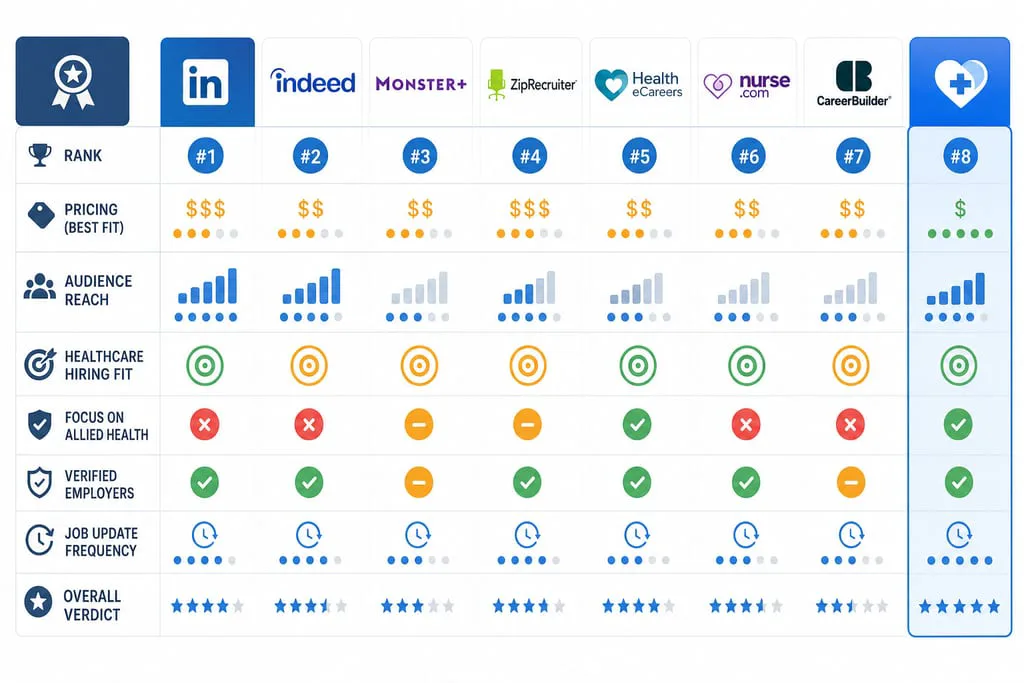
Six platforms come up most often when allied health employers compare price against reach: LinkedIn, Indeed, Monster+, ZipRecruiter, healthcare-specific boards like Health eCareers, Nurse.com, and CareerBuilder, and allied-health-only boards. Each one trades cost for audience size in a different way, and the right pick depends on whether you need volume or a tighter match for a specific certification like ARRT or RRT.
| Board | Starting Price | Reach |
|---|---|---|
| Free, or $200-$1,000/month Job Slots | Dedicated healthcare hiring page, broad professional network | |
| Indeed | Free for 3 jobs/month, sponsored CPC from ~$5/day | 250M+ monthly users |
| Monster+ | $8/day Standard or $299/month Pro | Owned by Bold Holdings after a 2025 bankruptcy sale |
| ZipRecruiter | Typically starts near $299/job | General job seeker audience |
| Health eCareers, Nurse.com, CareerBuilder | Pricing not published | Healthcare-focused candidate pools |
| Allied-health-only boards | Free posting on some | Allied health roles only, no physician or nurse listings |
The general boards still win on sheer applicant count, since Indeed's user base alone dwarfs any niche site. But niche boards win on fit, because a medical assistant or cardiac sonographer post isn't competing against thousands of unrelated admin and nursing listings for attention.
LinkedIn Pricing and Reach for Healthcare Hiring
LinkedIn's free tier gives you one active job listing at a time, and it does not stay up forever. The post pauses automatically after 14 days, then expires at 30 days unless you promote it or close it out yourself.
Promoting a post moves you into a pay-per-click auction. The minimum daily budget runs $7 to $10, average U.S. cost-per-click lands between $1.50 and $4.50, and LinkedIn's own data puts the average cost per applicant at about $2.83. A $10-a-day budget run for 30 days comes out to $300 or less, by LinkedIn's own example.
Enterprise Job Slots work differently. You pay $200 to $1,000 per slot per month on an annual contract, and prepaying the full year can cut your CPC costs by up to 35%. LinkedIn also runs a dedicated Healthcare hiring page at business.linkedin.com/hire, sitting alongside separate pages for staffing agencies, nonprofits, and government employers.
- Free listing: one post, 14-day pause, 30-day expiration
- Promoted post: $7-$10/day minimum, ~$2.83 average cost per applicant
- Job Slots: $200-$1,000/slot/month, annual contract
- Prepay discount: up to 35% off CPC when paid annually
Indeed Pricing and Reach for Healthcare Hiring
Indeed's free tier covers up to 3 jobs a month, each staying live for 30 days, but a free post loses visibility fast as newer listings push it down the results page. That's the tradeoff: no cost, but shrinking exposure the longer it sits.
Sponsored Jobs bills on the 1st of the month or once you hit $500 in spend, whichever comes first, and CPC plans often start around $5 a day. Indeed reports more than 250 million monthly users, per Forbes Advisor data cited in 2026, which is the largest raw audience of any board covered here.
For specialty roles like radiology tech or respiratory therapist, Indeed's Tech Network pushes your post out to over 50 specialty job sites with a combined 500 million monthly visits. Employers using that network saw a reported 4.1X increase in relevant applications, and Indeed connects to 300+ applicant tracking systems so the posting can flow straight into your existing hiring software.
- Free tier: 3 jobs/month, 30 days each, visibility fades over time
- Sponsored billing: 1st of month or $500 spend, whichever hits first
- CPC starting point: around $5/day
- Tech Network: 50+ sites, 500M monthly visits, 4.1X relevant applications
Monster Plus and CareerBuilder After the Merger
Monster and CareerBuilder are now one operation, and the path there was not smooth. The merged company filed for Chapter 11 bankruptcy in June 2025 while carrying $392.5 million in debt.
Bold Holdings bought both boards at auction for $28.4 million, and that sale closed on July 31, 2025. Current pricing runs through Monster+, with two tiers employers should know before picking a plan:
- Monster+ Standard: $8/day pay-as-you-go, billed on candidate clicks
- Monster+ Pro: $299/month or $2,990/year, adds resume search and 299 monthly credits
- Ownership: Bold Holdings, post-acquisition as of July 31, 2025
For an allied health employer, the $8/day Standard tier is the lower-risk entry point since it only charges when a candidate clicks, while Pro makes more sense if you're actively searching resumes for certifications like ARRT or RRT rather than waiting on inbound applicants.
Niche Boards Built for Allied Health Candidates
ZipRecruiter plans commonly start near $299 per job and can climb past $700 once you add features, and the audience behind that price is general, not clinical. Health eCareers and Nurse.com target clinical and allied health candidates more directly, though their exact 2026 pricing and reach numbers are not published anywhere an employer can check in advance.
Legacy boards like Monster and CareerBuilder often run $300 to $450 a month for bundled posting and resume database access, which puts them in the same price range as ZipRecruiter without a sharper audience match. Allied Healthcare Jobs takes a different approach: employers can post a job for free, every listing on the site is an allied health role, and employer details get verified across the web before the post goes live, which keeps admin and nursing roles from crowding out a surgical tech or phlebotomist posting the way they can on Indeed.
- ZipRecruiter: ~$299 to $700+/job, general audience
- Health eCareers, Nurse.com: clinical focus, pricing not published
- Monster, CareerBuilder: $300-$450/month bundled
- Allied Healthcare Jobs: free posting, allied health only, employer details verified
Fit matters as much as price when you're hiring for a role with a certification requirement attached, since a CMA or RRT listing buried in a general feed gets far fewer qualified clicks than the same post sitting in front of candidates already searching by role.
Reach Versus Fit, Pick Your Problem
A $5-a-day Indeed post and a free allied-health-only post are not competing for the same job. Indeed puts your CT tech opening in front of 250 million people who are mostly looking for retail, warehouse, or office work. A free post on a board built only for techs and therapists reaches far fewer people, but almost all of them already have the certification or scope you're hiring for.
Volume pricing only pays off at volume. LinkedIn's Job Slots at $200 to $1,000 a month and Monster+ Pro at $299 a month make sense for a hospital system filling 40 openings a quarter across radiology, respiratory, and surgical services. A single clinic or surgery center hiring one CMA or one surgical tech is paying enterprise rates for a problem they don't have.
Screening time is the hidden cost nobody prices into the sticker number. Posting on a general board means wading through physician and nurse applicants who clicked the wrong listing, where a role-specific board only shows you people searching for "phlebotomist" or "ultrasound tech" in the first place.
| Hiring situation | Better fit | Why |
|---|---|---|
| Single clinic, one opening | Free allied-health board | No cost, no off-target applicants |
| Hospital system, 40+ openings/quarter | Enterprise Job Slots or Monster+ Pro | Volume pricing justifies the monthly fee |
| Rural clinic, hard-to-fill RRT role | Niche board over Indeed free tier | Visibility doesn't fade behind newer generic posts |
| Travel contract staffing | General board with CPC budget | Needs broader geographic reach fast |
A surgery center filling a single Surgical Technician role gets more out of a free, role-specific post than a $5-a-day Indeed campaign that has to compete against admin and retail listings for the same budget. A hospital network filling dozens of radiology and respiratory seats a month is the one case where paying for Job Slots or Monster+ Pro earns back its cost in sheer reach.
What to Post Where, Starting This Week
Pick one opening you need to fill right now and match it to your hiring volume, not to which name sounds biggest. If you're filling a single CMA, phlebotomist, or surgical tech seat, post it free on a role-specific board like Allied Healthcare Jobs before you spend a dollar anywhere else, since every listing there is already allied health and your post won't sit behind retail and admin jobs the way it would on a general site. Only move money toward LinkedIn Job Slots or Monster+ Pro once you're filling a dozen or more seats a quarter across departments, because that's the volume where $200 to $1,000 a month actually earns its keep. One free post, checked against one open role, is the only decision that matters before you spend anything.
Hiring Questions Employers Still Have
Can I post the same allied health opening on more than one board at once?
Yes, nothing stops you from posting the same CMA or surgical tech opening on LinkedIn, Indeed, and a role-specific board at the same time. Each board bills and ranks posts separately, so running a free post on one site does not block a paid post on another. The only cost is your own time managing separate applicant inboxes for the same role.
Will a free post on a general board like LinkedIn or Indeed actually reach qualified techs and therapists?
It can, but a free post fades fast and competes against far more unrelated listings than a paid or niche post does. LinkedIn's free tier allows one listing that pauses at 14 days, and Indeed's free tier pushes older posts down the page as new ones arrive. A radiology tech or respiratory therapist opening sitting in a general feed still has to outlast that churn before the right candidate sees it.
How do I know if a niche healthcare board actually has candidates in my city?
Check the board's location browsing before you post, not after. Allied Healthcare Jobs, for example, lets employers look at job activity by city, state, and ZIP, so you can see whether surgical techs or sonographers are searching in your area before committing a listing to that market. A board with no visible activity in your city is a sign to try a broader one alongside it, not instead of it.
What happens to my job post if I never upgrade to a paid plan?
On LinkedIn, an unpromoted free post expires automatically at 30 days and simply stops appearing. On Indeed, a free post stays live for its full 30 days but keeps losing visibility as newer jobs get added above it. Either way, the listing does not disappear without warning, it just stops getting clicks long before the expiration date hits.