How to Become a Registered Medical Assistant
Learn how to become a registered medical assistant, from eligibility rules to exam day, plus where RMAs find jobs that pay well.

To become a registered medical assistant, you need to meet one of three eligibility routes set by American Medical Technologists, then pass their national exam. RMA is not just a casual title for anyone doing MA work. It is a specific credential issued by AMT, separate from the CMA credential issued by the American Association of Medical Assistants. Both let you work as a medical assistant, but employers may list one or the other by name in a job posting, so knowing which one you hold matters when you apply.
Most people qualify through a formal training program, but that is not the only door in. AMT also allows candidates in through military medical training or through enough years of hands-on work experience as a medical assistant. Once you meet one of those paths, you still have to pass a national exam covering clinical and administrative skills, and clear a background check before AMT issues the credential. None of that happens automatically just because you finished school or worked the job for a while.
Table of Contents
What RMA Means and Why It Matters
RMA stands for Registered Medical Assistant, a credential issued only by American Medical Technologists. AMT sets the eligibility routes, writes the exam, and runs the background check, so the letters RMA always trace back to that one body.
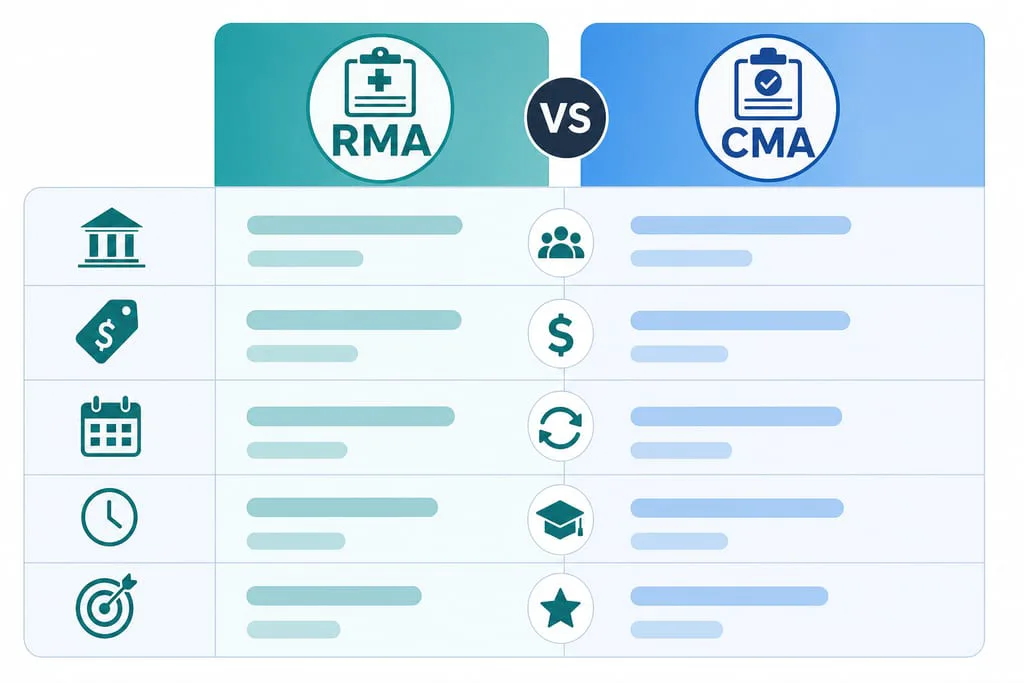
CMA, by contrast, comes from the American Association of Medical Assistants, a different organization with its own exam and its own rules. Employers across clinics and hospitals accept both credentials, but the exam content, cost, and renewal schedule are not identical, so you want to know which one a job posting is actually asking for.
| Feature | RMA | CMA |
|---|---|---|
| Issuing body | American Medical Technologists | American Association of Medical Assistants |
| Exam cost | About $150 | About $125-$250 |
| Renewal cycle | Every 3 years | Every 60 months |
| CE requirement | 30 points per cycle | 60 hours per cycle |
Pick the credential that matches the path already open to you, whether that is a program ending in an AMT-aligned exam or one set up for the AAMA route. Either credential gets you hired, but you cannot swap one exam score for the other, so check which one your training program or employer expects before you register (more detail on the RMA path here).
Who Qualifies to Sit for the RMA Exam
Every RMA candidate has to clear three baseline rules before AMT even looks at which pathway applies. You must be at least 18 years old, hold a high school diploma or GED, and pass a background check run through AMT's screening process. These apply no matter which of the three qualifying routes you take.
Pathway one covers graduates of a medical assisting program accredited by CAAHEP or ABHES. This is the route most schools build their curriculum around, and it's the one most employers recognize on sight. Pathway two covers military-trained candidates who completed medical services training through a branch of the armed forces, such as a combat medic or Navy corpsman program. Pathway three covers work experience: AMT requires five years of full-time MA experience with limited time spent as a classroom instructor, verified directly by your employer.
- Accredited program graduate: diploma or transcript from CAAHEP or ABHES school
- Military route: DD-214 or training records showing medical services coursework
- Experience route: five years verified by employer letter, no formal program needed
- All three: age 18+, high school diploma or GED, cleared background check
Choosing Your Qualifying Path
Your background decides which path makes sense, not personal preference. Someone with no healthcare experience should look at an accredited program, which typically runs 9 to 24 months depending on whether it's a certificate or associate degree track. A veteran with corpsman or combat medic training already has the clinical hours AMT wants, so the military route skips the classroom entirely.
If you're already working full-time as an unregistered MA in a clinic, the experience route lets you sit for the exam without going back to school, as long as your employer will sign off on your five years. Before enrolling anywhere, confirm accreditation directly on the CAAHEP or ABHES website rather than trusting a school's own claim.
- No healthcare background: enroll in a CAAHEP or ABHES accredited program
- Veteran with corpsman training: use the military equivalency route
- Working unregistered MA with five years: pursue the experience pathway
- Any program under consideration: verify accreditation on the agency's own site before paying tuition
Passing the RMA Certification Exam
You apply directly through AMT, submitting proof of your qualifying pathway along with the exam fee. Once AMT confirms your eligibility, you schedule a computer-based test covering general medical knowledge, administrative duties like scheduling and billing, and clinical duties like phlebotomy and vital signs.
Scores come back the same day at the test center, and if you don't pass, AMT lets you retake the exam after a waiting period set by AMT's retest policy, which you confirm when you get your score report. Most candidates move from application approval to a scheduled test date in a few weeks, since testing centers run on a rolling calendar.
- Submit application with proof of pathway and exam fee to AMT
- Wait for eligibility confirmation before scheduling a seat
- Take the computer-based exam at an approved testing center
- Receive your score the same day, pass or retest
Keeping Your RMA Credential Active
RMA certification runs on a three-year renewal cycle set by AMT, and keeping it active requires 30 continuing education points per cycle. If renewal lapses, you have to complete reinstatement steps through AMT before the credential is valid again, which can mean extra paperwork and fees on top of the CE you already owe.
Holding an active RMA generally opens doors that an uncertified MA title doesn't, since many clinics and hospitals list the credential as a hard requirement in the job posting itself. Once you're certified, searching listings by credential, like on Allied Healthcare Jobs, makes it easier to find postings that specifically call for RMA over CMA or no certification at all.
- Track your 30 CE points across each three-year cycle, not just at renewal time
- Submit renewal paperwork and fee before your expiration date, not after
- If lapsed, complete AMT's reinstatement process before applying to credentialed roles
- Search job boards by RMA requirement to target postings that match your credential
RMA, CMA, or No Certification: Which Fits You
Job postings rarely spell out why they want RMA over CMA. Most hiring managers write "CMA/RMA or equivalent" because their system cares about the exam, not the acronym. That means your decision often comes down to which pathway fits your background, not which letters look better on a resume.
If you already work as an unregistered MA with five years of full-time experience, RMA skips tuition entirely. CMA has no equivalent work-experience route, so anyone without a program or military background has to go through AMT to certify without going back to school. That gap is the real reason RMA tends to win for people who have been doing the job without the title.
Staying uncertified costs you reach, not just pay. Certified MAs show up in more searches because employers filter by credential, and many postings list CMA or RMA as a hard requirement with no exceptions. An uncertified MA can still find work, but the pool of postings open to them shrinks fast once a clinic or hospital writes certification into the job description.
- Formal program grad, no work history: either CMA or RMA works, pick based on which exam your school prepared you for
- Five years unregistered MA experience, no program: RMA's experience pathway applies, CMA does not
- Military medical training, no civilian program: RMA's military route applies directly
- No certification, applying cold: fewer postings open, and most hospital systems will not interview without one
Before you apply anywhere, read the certification line on the listing itself. Some postings accept either credential, some name one specifically, and applying to a posting that requires RMA when you hold CMA, or the reverse, wastes a submission that could have gone to a job that actually matches what you carry.
Where to Look Once You Hold the Credential
Once your RMA is active, the search gets narrower and more specific: look for postings that list the credential by name, state the pay range, and spell out the setting, whether that's a clinic, hospital, or specialty practice. Allied Healthcare Jobs filters medical assistant listings by certification requirement, so you can pull up openings that ask for RMA specifically instead of sorting through generic admin roles or postings that never mention pay at all. Browse current listings directly, or sign up for the weekly alert if you'd rather have RMA-specific roles land in your inbox once a week instead of checking daily. Either way, you're applying with a credential that most of those listings already require, which is the whole point of going through AMT in the first place.
RMA Eligibility Questions and Concerns
Can I switch from the work experience path to the accredited program path if I get rejected?
Yes, AMT lets you apply under a different pathway if your first application does not qualify. If your five years of experience gets turned down because your employer cannot verify enough hours or the right scope of work, you can enroll in a CAAHEP or ABHES accredited program instead and apply again once you graduate. The two pathways are separate applications, so a rejection on one does not block the other.
Does a misdemeanor on my background check automatically disqualify me from RMA eligibility?
No, a misdemeanor does not automatically disqualify you. AMT reviews background check results case by case, looking at the type of offense, how long ago it happened, and whether it relates to patient care or safety. A drug-related or violent offense carries more weight than an old traffic misdemeanor. If you have anything on your record, contact AMT directly before you apply so you know where you stand before paying the exam fee.
Will an RMA credential earned through military experience transfer if I change states?
Yes, RMA is a national credential, not a state license, so it transfers with you no matter which state you work in. AMT issues the credential once, and employers anywhere in the country recognize it the same way. Once you have it, you can search listings by state on a site like Allied Healthcare Jobs to find openings that ask for RMA specifically in your new location.
What happens to my RMA eligibility if my accredited program loses its accreditation after I graduate?
Your eligibility stays intact if your program was accredited at the time you graduated. AMT checks accreditation status as of your graduation date, not your application date, so a school losing CAAHEP or ABHES status later does not undo a credential you already hold or an application already approved. Keep your diploma, transcript, and the accreditation dates on file in case AMT ever asks for proof.