How to Become a Medical Assistant in California
Learn how to become a medical assistant in California, from training rules to CDPH scope limits, certification, and landing your first job.
By David Nix
Published

If you want to know how to become a medical assistant in California, here's the short version: there's no state license to earn, but you do need a set number of training hours before you can touch a needle or give an injection, and most people get through training and into a clinic job in 9 to 12 months. California is different from a lot of states here. Instead of one state board exam, the path runs through an approved training program, hands-on skills checkoffs for things like phlebotomy and injections, and your employer confirming you've met the hour requirements before you work unsupervised in those tasks.
The process has three parts: classroom and clinical training, a skills checkoff where an instructor or supervisor signs off that you can safely perform specific procedures, and employer verification once you're hired. California law sets minimum hour requirements for tasks like injections and blood draws, so your certificate or transcript needs to show you actually logged that training, not just sat through lecture. Certification through a group like AAMA or NHA is optional in California, but most clinics and hospitals ask for it anyway because it signals you've already met those skills standards.
Table of Contents
Why California Rules Differ From Other States
California puts medical assistant scope and training under the Medical Board of California and the California Department of Public Health, not under a licensing board like it would for a nurse or radiologic tech. The Business and Professions Code lays out exact hour minimums for specific tasks, including injections, venipuncture, and skin tests, and those hours are tied to the procedure, not to a general MA certificate. This means two MAs trained at different schools can have different clearances depending on which procedures their programs logged.
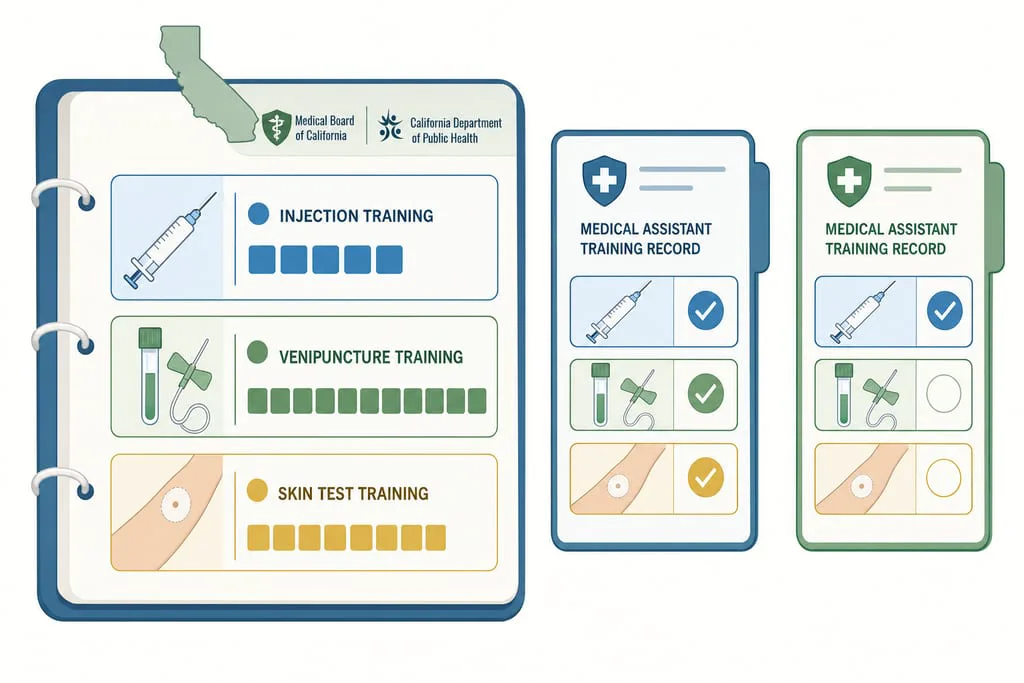
There is no state-issued MA license to carry around, so there's nothing to renew and no license number to list on a resume. Instead, your training transcript and your employer's records are the proof that you met the hour requirements for each task. An employer can legally let you draw blood or give an injection only after they've confirmed those hours exist, which is why some new hires spend their first weeks doing intake and rooming work before they're cleared for needle-based tasks.
| Requirement | California | Typical other state |
|---|---|---|
| License to practice | None required | Often none, but some states require certification |
| Proof of readiness | Logged training hours per task | Program completion certificate |
| Who confirms scope | Employer, based on records | Employer or state certifying board |
| Oversight body | Medical Board of California, CDPH | Varies by state medical board |
A program's hour log matters more in California than the name of the school you attended, according to the California Institute of Technical Studies. Ask any program directly how many hours they log for injections and blood draws before you enroll.
Meeting California's Training Hour Requirements
California sets specific hour minimums for the tasks that carry the most risk: injections, venipuncture, and skin testing. These hours split into theory and practical time, and a program has to document both before an employer will let you perform the task unsupervised.
Venipuncture and skin testing each carry their own hour minimums, separate from injections. A school that only logs general "clinical hours" without breaking them out by task leaves you with paperwork an employer can't use. Ask for a breakdown by procedure, not a single combined number.
Accredited programs build these hour splits into the curriculum from day one, because they know employers will ask. Unaccredited or shortcut programs sometimes skip this, leaving graduates with a certificate but no usable proof for the tasks that matter most.
- Training certificate showing program completion date
- Hour log broken out by injections, venipuncture, and skin testing
- Instructor sign-off or skills checkoff sheet
- Clinical site name and supervising instructor contact
Keep copies of everything. HR departments at larger clinics and hospitals will ask to see these documents before clearing you for needle-based work, and a missing page can delay your start date by weeks.
Choosing a Program That Covers California Law
Pick a program that teaches California's task-based hour rules directly, not a national curriculum with California mentioned as a footnote. Community colleges and accredited vocational schools in the state usually build their hour counts around what California actually requires, since they place students into California clinics for externships.
Call or email the program before you enroll and ask whether they log injection, venipuncture, and skin test hours as separate categories. A program that can't answer that question clearly probably isn't tracking it the way employers expect.
Externship placement matters as much as classroom time. Many California clinics want to see hands-on hours completed before they'll even interview you, so a program with weak externship connections can cost you weeks of job searching later.
- Confirm the program tracks hours by task, not just total clinical hours
- Ask how many externship sites they place students with locally
- Check if the program is a certificate (6-12 months) or an associate degree (longer, with general ed credit)
- Request a sample hour log from a recent graduate if possible
A certificate program typically runs 6 to 12 months, while an associate degree takes longer but adds credits that can transfer toward a bachelor's later if you want to move into nursing or health administration.
Getting Certified and Understanding Your Scope
National certification is not required by California law, but most hospitals and larger clinics ask for it anyway. The three credentials employers recognize most are CMA through AAMA, RMA, and CCMA, each backed by an exam and a renewal cycle.
Certification signals you've already met a skills standard, which can shortcut some of the employer verification steps covered earlier. It doesn't replace the task-specific hour logs California requires, it sits alongside them.
Scope limits apply no matter which credential you hold. A California medical assistant cannot diagnose, prescribe, or perform any task that hasn't been specifically delegated and supervised by the physician. BLS/CPR certification is commonly required alongside your MA training before a clinic will put you on the floor.
- CMA (AAMA): requires graduation from a CAAHEP or ABHES accredited program
- RMA: accepts graduates from accredited and some non-accredited programs
- CCMA: exam-based, often chosen by career-changers with relevant work history
- BLS/CPR: usually required before clinical duties begin, regardless of which MA credential you pick
Check the renewal cycle for whichever credential you choose, since lapses can affect your standing with an employer even though the state itself doesn't track your certification status.
Finding Your First Medical Assistant Job
California employers list their certification and training requirements directly in the job posting, so read the fine print before you apply. A posting asking for CMA or RMA plus proof of injection hours is telling you exactly what paperwork to bring to the interview.
Entry-level and trainee roles exist for people who finished training but haven't sat for a certification exam yet. These postings usually pay less but give you the supervised hours needed to round out your scope before you test.
Searching by city or ZIP on a board built specifically for allied health roles surfaces openings with pay ranges and scope details listed upfront, instead of buried in generic admin postings. Allied Healthcare Jobs filters California medical assistant listings by certification requirement and pay range, separate from the nursing and office admin roles that crowd general job boards.
- Training certificate and task-specific hour logs, ready to upload or bring to interview
- Current BLS/CPR card
- Certification status, or a clear plan for when you'll test
- Résumé listing which procedures you're cleared for, not just "clinical experience"
Bring all four to your first interview, since a clinic that can verify your hours on the spot can often clear you for needle-based tasks faster than one that has to chase paperwork after you're hired.
Certify Early or Work First, Which Path Fits You
Some new MAs chase a CMA or RMA exam before applying anywhere, assuming California requires it. That costs weeks of study and exam fees for a credential the state doesn't mandate, while a trainee role sitting open right now would have paid you to build the same skills.
Skipping the hour log is the opposite mistake. A graduate who treats training as "done" once the certificate prints often can't answer when HR asks for a task-by-task breakdown, and that gap stalls a start date far longer than finishing the paperwork up front would have.
Scope confusion shows up on the job, not in the classroom. An MA who draws blood or gives an injection before the employer has confirmed those specific hours is operating outside delegated duties, and that's a compliance problem for both the MA and the clinic, not just a paperwork delay.
Matching your training level to the posting is its own decision. Apply for a role that lists injection and venipuncture hours you don't have yet, and you'll get screened out before an interview; apply for a trainee posting instead, and you build the missing hours while earning a paycheck.
- Chasing certification first: costs time and money, not legally required, but can shortcut employer checks later
- Skipping hour documentation: feels faster at the time, creates delays once HR asks for proof
- Working beyond delegated scope: no upfront cost, but creates compliance risk for you and the employer
- Applying below your logged hours: slower income, but builds the exact hours a target posting requires
Compare Your Hours Against What California Clinics Are Actually Asking For
Pull your training transcript and your hour log out right now and line them up against real California postings, not a generic national job list. Search by Medical Assistant specifically, since a broad admin search will bury CMA and RMA listings under receptionist and office roles that don't reflect MA scope at all. Allied Healthcare Jobs lets you filter by role and location so you see which clinics want injection and venipuncture hours you already have, and which ones want hours you still need to log. Sign up for job alerts there too, so new California MA postings land in your inbox as clinics add them instead of you checking back every few days.
Medical Assistant Questions in California
Can I perform injections in California without completing the state-specific hour requirement?
No. California law ties injection authority to logged hours, not to a certificate alone, and an employer who lets you give injections without those hours on record is breaking state rules. If your transcript doesn't show injection hours broken out separately, you'll be assigned rooming or intake work until a program or employer can log them for you.
Do California medical assistant rules change if I'm hired by a plasma center instead of a clinic?
The hour requirements stay the same, but plasma centers often lean harder on venipuncture hours specifically, since that's most of the job. Ask the center during your interview which tasks they need documented before your start date, since a plasma role can clear you faster on draws but still hold you back on injections until those hours are verified separately.
Will a medical assistant certificate from another state count toward California's hour requirements?
Only if the out-of-state program logged hours by specific task the way California requires, not as a combined clinical total. Pull your transcript and check whether injections, venipuncture, and skin testing are broken out individually. If they're lumped together, a California employer may ask you to complete additional supervised hours before clearing you for those tasks.
What happens if my employer asks me to perform a task outside my delegated scope?
You can decline, and you should, since performing a task without logged hours or physician delegation creates legal risk for you, not just the clinic. Ask for the request in writing or flag it to a supervisor on the spot. If this keeps happening, it's worth searching for a different employer through a board like Allied Healthcare Jobs, where postings list scope and certification requirements upfront.